divendres, 22 de febrer del 2019

How to face the education of the future today


I have had the pleasure of attending the second World Education Congress held in Santiago de Compostela, during this vacation. I had the privilege of presenting the research I am carrying out on the Pedagogical Contributions of Homeschooling when applied to a traditional school environment. In addition to exchanging experiences in education with other teachers, I enjoyed participating in the many seminars on various current issues in the world of education. Topics addressed included: How to face the education of the future today, the challenges and difficulties of working with young people and how to be a good teacher. I can summarize the general topics in three points:
Firstly, school helps to discover the individual talents of each student. Each child is gifted in a particular area. We must help children in developing their skills and encourage those who enjoy succeeding. It is been said that success is dedicating your life to pursuing your talents as well as what you like through your work and profession.
Concerning topics that have been discussed in different seminars are the dangers that of misusing of social networks, cyberbulling, sexual harassment on the Internet, online gambling, misusing of video games, (spending too many hours playing, as the great majority of the videogames show excessive violence), consuming pornography every day in younger ages, promiscuity, adolescents using Viagra, unwanted pregnancies, rape, consuming toxic substances such as tobacco, drugs, alcohol, stress pills... These are complicated issues that surprise experts considering that statistics are increasing year after year as ages of exposure decrease. Parents must educate and discipline their children no matter how well behaved they are because all of these dangers exist.
Finally, I would emphasize that most of the speakers required teachers to love their pupils and have passion for their work. Being a teacher implies a total dedication to students; More than a job this is a lifestyle. Children value good teachers. They are very influential for students and when a child feels treated with love and respect, their learning improves. It is easier to learn and develop our abilities in an environment where we feel loved, capable and respected.
Be aware parents and teachers, times are not easy for our children.


dimarts, 8 de gener del 2019

Center of Interest

Center of Interest
Ovide Decroly was born at the end of 19th century. He is well a know pedagogue. Decroly has influenced the pedagogy around “Escola nova”. He believes that the purpose of the school is to help students be ready for the world, whatever the future holds. Education it is about allowing children to gain experiences, to learn to live in new and better ways, to take charge of their future, to shape it and deal with its challenges. Decroly refused traditional education, he proposed an education connected with the primary needs of the child and their natural interests. He promoted Center of Interest, promoting activities based on observation, small research, exploration of the environment, using the associations within the space, time, phenomena, objects, facts and people.
He give us some examples to implement in the school:
-We have to take the students to the forest, farms and fields around the school. Immersion in real nature as often as possible through the crops, breeding animals, botanic trips, zoological trips and so on.
-We have to show to the children the workshops around our area, letting them practise whenever it is possible different profession and crafts such as a carpentry, shoemaking, dressmaking, baking…
-We have to show the social rules of society, municipal organisation and practise them, visit the Mayor or the city council, we can also implement some of the rules in the class, given the students duties and responsibilities.
Decroly thinks that schools should work as a restaurant. The teacher should offer different meals to the students, having different quantities and a wide range of different ingredients to nurture the inquisitive desire to learn from the children. This is a good way to personalise education and follow the children’s interests. 


diumenge, 2 de desembre del 2018

Born to Learn

We all agree that we are born with a limitless capacity to learn. Children are insatiably curious, we can see that in their inquisitive eyes. They observe the world and, as soon as they acquire and master language when they turn three or four years old, they question everything. Humans are so much more inquisitive than other creatures, we are born to learn. Why does school sometimes go so badly wrong with some students? Are schools built on the assumption that children were born to learn or that children were born to be taught? The tension between teaching and learning has filled thousands and thousands of pedagogical books. For so many children the wonder of learning has been replaced by the tedium of trying to memorize what they were taught about things which really didn’t interest them very much in the first place. To follow the children’s interests and to respect the rhythm of each child in a class of 25 is impossible. It seems obvious that reducing class sizes it is the first step. Confucius famously said: ‘Tell me, and I forget; Show me, and I remember; Let me do, and I understand.’ Learning is a consequence of having to work things out by yourself. In school we have to promote independent and creative thinking to solve problems. Learning to do is one of the four pillars of education, to enable students to acquire competence and skills. Promoting work experience, becoming apprentices for a day or a week, transforming the class into a workshop, visiting museums and expositions often, these are good ideas for fostering learning. Children are born to learn, let’s make it possible in school!


dimarts, 30 d’octubre del 2018

Let's talk methodology

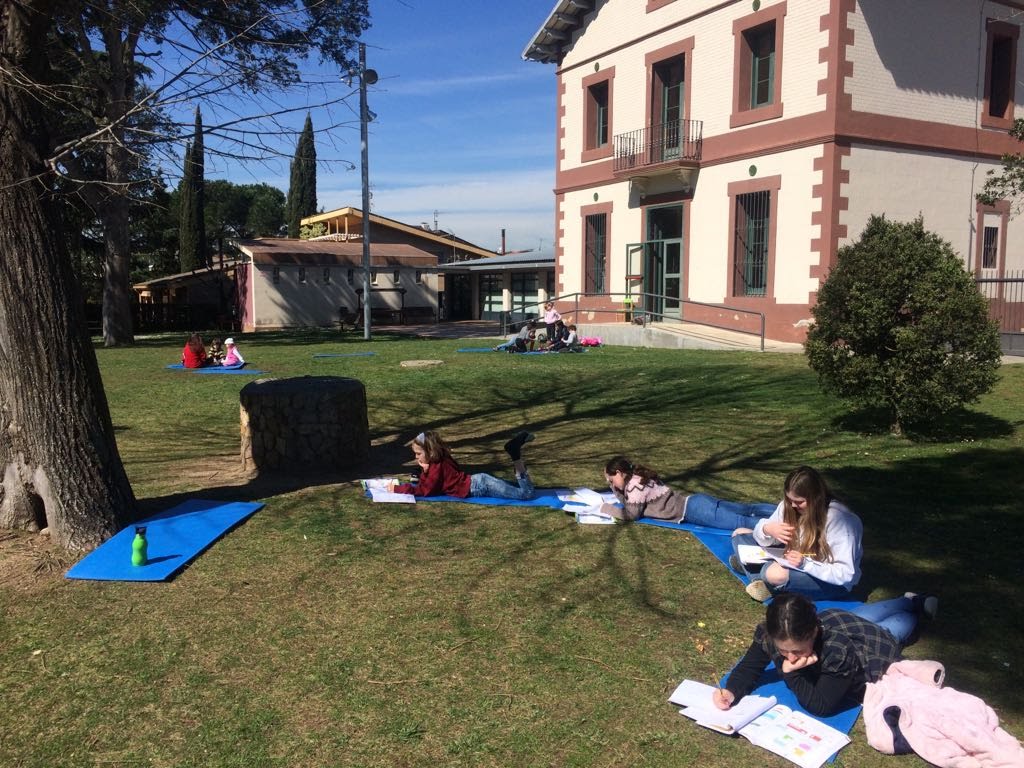
Rosa Sensat (1914), one my favourite Catalan educationalist from Escola Nova movement, says that in life knowing how to use knowledge in daily life is more important than the acquisition of knowledge.  Her methodology has an important role in our pedagogy. Lessons normally begin with a conversation following a specific order: first we use our senses, children touch and observe things; second we find out what previous knowledge they have through appropriate questioning; third, through indirect suggestions we discover together what should we know more about the topic. A lesson is often a project, in the class we design a plan, a syllabus to be executed in a short period of time. There is a question, there is dialogue and there is discussion about the selection of resources and different courses of action. The class can then take place beyond the school if necessary, in a museum, in the forest or under a tree thereby promoting context and meaning in the topic environment.  'The lessons that students learn in the playground are more useful than the lessons we teach them in the class,' (Rousseau, 1762).


diumenge, 30 de setembre del 2018

Guerrilla Learning

Guerrilla Learning: How to give your kids a real education with or without school
is the provocative title of an amazing book written by Grace Llewellyn nearly 20 years ago. Llewellyn is both a teacher and a researcher. She considers that school is a waste of time and that students learn better when they are self-motivated and not locked inside the school walls. Llewellyn is well known in the homeschooling world. However, she prefers to use the term ‘unschooling’ as she considers that homeschooling denotes moving the school to the home. She defines unschooling as a learning method that has no formal structure or curriculum vitae.

What can we learn from her Guerrilla Learning as a school? Llewellyn challenges students to turn off the television, go abroad, visit libraries, museums, use internet and other resources to research and learn. She mentions five keys essentials for the learning process. These are: opportunity, time, interest, freedom and support. 

Opportunity
Having access to reading, writing, dialogue, arts, mathematics and logic, science and nature, the community and the future. Immersion in knowledge and culture.
Timing
This refers to cognitive age and to respect of each child’s developmental rhythm. Vygotsky would define this as working within the zone of proximal development.
Interest
We don't have to motivate children to learn different concepts and skills and expect them to show interest. We need to wait, as motivation should arise from the children, not from the teacher. When a child is motivated by something then it is the right time to learn.
Freedom
Giving children freedom so they can choose when, how and what to learn, following their own rhythms and interests, allowing themselves to self-regulate without imposing our schedules, timetables and demands.
Support
When it is needed and requested, providing materials, resources, explanations, celebrating their mistakes, successes and especially - the most important - witnessing their success.

We can observe these five keys in our life and in the life of our children.


dijous, 21 de juny del 2018

Summer Performance

We have enjoyed so much the last performance. The children have been doing very well. Enjoy the show and see you next september.


dissabte, 5 de maig del 2018

Synonyms flowers

This week in English, the children have been writing their non-fiction reports about electricity. They have been writing them in neat with pictures, captions and labels and will be thinking about the layout of their reports before it goes up on display. 
We have begun learning about Van Gogh this week. Did you know that he painted around 2000 paintings but only sold one whilst he was alive? We looked at and discussed his most popular pictures and talked about which one we liked the most. Vincent Van Gogh used to paint pictures of things he saw in his dreams so we had a go at doing some pictures of our dreams too! Next week we will continue with this theme and eventually paint our own ‘Starry Night’ pictures!
The older children consolidated their knowledge of decimals and column subtraction through mathematical problems involving money. We studied word problems and learned the invaluable lesson of looking closely at what the question asks us. 
This proved useful for our Cambridge exams which all the older children took part in this week. Well done to everyone for completing all six tests, it's not an easy thing to do! 
In English, we learnt about synonyms, these are groups of words that all have the same meanings as each other. We made synonym flowers for one of our classroom displays and played synonym card games with Markus. 
Finally, we were introduced to our new topic: The Romans. All the children are really excited to begin several new and interactive projects to work on for this exciting theme.


dijous, 29 de març del 2018

Working in pairs in a multi-level class

In a traditional classroom the teacher controls the class and there isn't a very active role for the students. 
Working in pairs makes students autonomous learners, they work collaboratively for their own learning. The classroom is transformed to a place where learners come together for interaction and can learn in a more natural way. According to recent research carried out by Domingo (2014) it has been shown that multi-level class and working in pairs its successful and beneficial for pupils. The older students have to prepare either an activity, workshop or topic, they have to design, prepare and find the resources and they have to manage the small group learning process. The teacher becomes an observer and helper of all the different groups running table to table. 
The older students are fully motivated to prepare their group, they are learning while they are planning the activity and doing research. During the class all of the students have an active role, the younger students are amazed by their also young teachers, they keep a high concentration during the activity. Once the workshop is done the learning group moves to another table to start a new activity, making the class very exciting and keeping motivation for the full session. In these classrooms we have been working as scientists with microscopes, electric circuits, we have been learning songs, drama, maths, solving problems, phonics, arts and crafts activities and we done experiments like the ants restaurant. 
These classes give a good opportunity for reinforcing learning and strengthening knowledge with all the class-mates improving their social skills. 


dilluns, 5 de març del 2018

Pedagogical contributions of Homeschooling

It is a big challenge to create a new school, especially when I have been so critical of other schools, curriculums and the acquisition of knowledge in traditional learning. A few years ago I had to homeschool my children because I didn’t agree with any of the schools and methods I had around. Most of them treat children like empty glasses that they have to fill up with concepts and information day after day for the full academic year. That’s how I became interested in the homeschooling movement. I have analysed in depth the benefits of homeschooling to transfer them into the classroom: this kind of education shows us a new approach to teaching and learning that can benefit the education system. The pedagogical qualities of this phenomenon are of great interest for educational research due to innovative solutions with attention to diversity, the participation of families in the school and the educational quality. ICT tools are also helping in this new movement too: ICT are new tools and especially a new field of learning. In EEUU some schools are offering their lessons online, so to attend the school in person is not compulsory anymore, you can learn by joining online or in virtual schools. It’s a new dimension called Flexischooling. ICT help us to personalise education thanks to several educational applications, programs and the constant communication between teachers, students and family. Families have strong responsibilities within their children's academic and personal achievements, the families are learning together, learning is a matter of life and they don’t separate living of learning. Education is a matter of love too, as family bonds are strength. School should promote these family bonds in the class too, parents are an essential part of the school life. In the school we are trying to implement this new approach and benefits from homeschooling encouraging the participation of the familiesin the school life, , presentation of projects, school trips, small class sizes and the use of ICT tools to personalise education.